
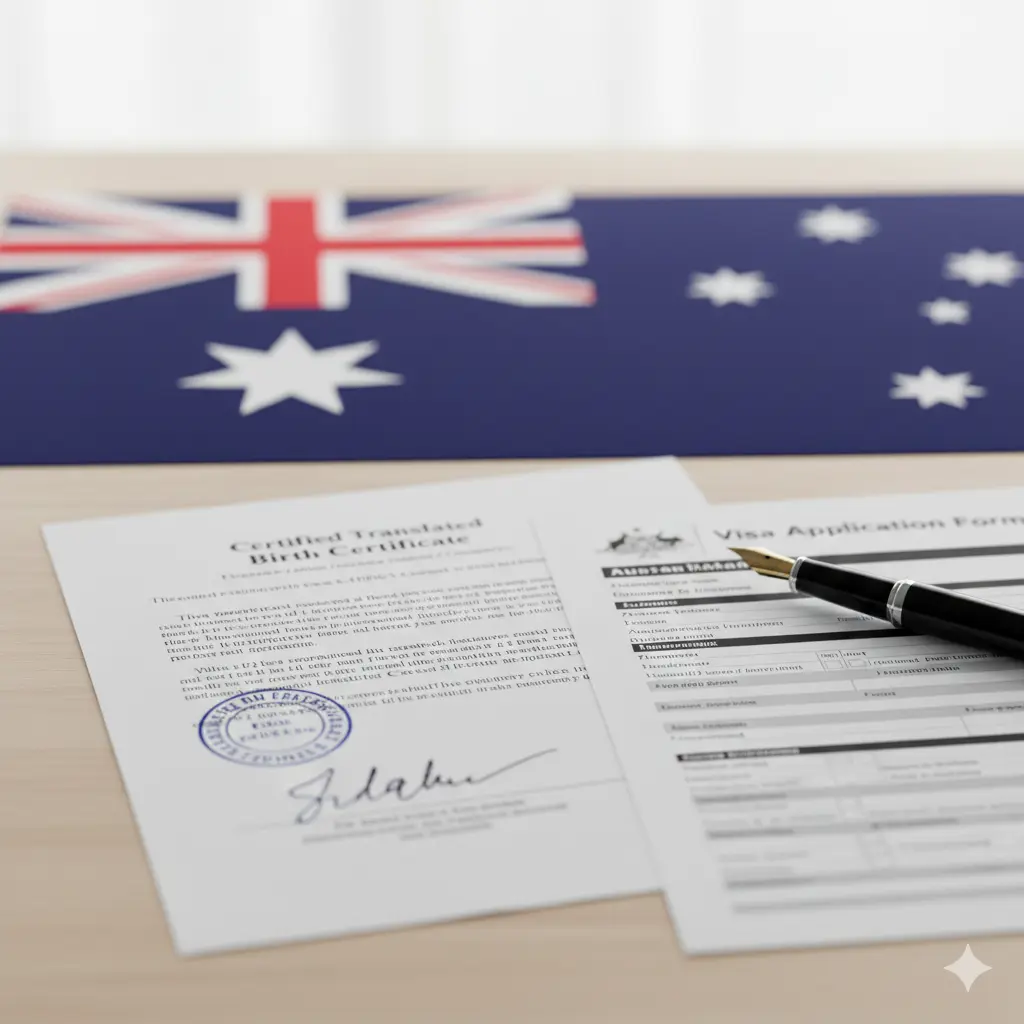
Applying for an Australian visa involves strict documentation requirements, and one of the most commonly requested documents is your birth certificate. If your certificate is not in English, you must submit a NAATI Birth Certificate Translation that meets immigration standards. Many applicants face delays or rejection simply because their translation was not done according to official rules.
This guide walks you through the entire process, from preparing your document to submitting the correct translation, so your application proceeds smoothly without unnecessary complications.
Why Australia Requires a NAATI Birth Certificate Translation
Australian immigration authorities only accept translations completed by certified translators. The translation must be accurate, verifiable, and legally valid. A simple translated copy created by a bilingual friend or local notary will not be accepted because the government must be able to trace the translator’s credentials.
A NAATI Birth Certificate Translation ensures the document has been translated by a professional recognized by the National Accreditation Authority for Translators and Interpreters. This certification confirms the translator has passed standardized language proficiency and legal translation assessments. As a result, the translation becomes legally acceptable for visa processing, university admission, PR applications, and partner visas.
Without this certification, immigration officers cannot confirm authenticity, and the document is treated as incomplete.
Step 1: Check Your Birth Certificate Quality
Before translation begins, your birth certificate must be clear and readable. Every detail must be visible, including seals, signatures, stamps, and registration numbers. If the document is damaged, faded, or partially cut, the translation may be rejected even if the translator is certified.
Scan the certificate in high resolution. Avoid mobile camera images taken at angles because distortion can make official seals unreadable. A clean scan ensures the translator can accurately reproduce all elements in the English version.
Step 2: Confirm Language Requirements For a NAATI Birth Certificate Translation
Not all birth certificates require translation. If your certificate is already fully in English, you do not need a NAATI Birth Certificate Translation. However, many certificates contain mixed languages where headings are in English but entries are in another language. In this situation, translation is still mandatory because immigration officers must understand every field, including names, dates, locations, and registrar notes.
You should carefully verify whether any handwritten or stamped information appears in a regional language, as this is a common reason applications are delayed.
Step 3: Submit the Document to Tranzlatex
Once your document is ready, the next stage is sending it to Tranzlatex for a NAATI Birth Certificate Translation. You simply upload a clear scan of your birth certificate through their submission channel or share it via email or WhatsApp as instructed. After receiving the file, their team reviews the document to confirm readability, language, and certification requirements for Australian immigration.
A NAATI-certified translator is then assigned to your case. The translator carefully studies the certificate and converts every visible element into English exactly as written, including stamps, seals, handwritten notes, and registry entries. Nothing is interpreted or simplified because immigration authorities require a precise legal reproduction of the original record.
During translation, date formats, administrative terminology, and registration references are standardized to match Australian immigration expectations while preserving the original meaning. Once completed, the translation proceeds to certification, ensuring it will be accepted for visa processing.
Step 4: Certification and Translator Declaration
After translation, the translator adds a certification statement. This is the most important component of a NAATI Birth Certificate Translation. The declaration includes the translator’s name, NAATI ID, signature, date of translation, and official stamp.
This section proves authenticity. Immigration officers use it to verify that the translation was completed by an accredited professional. Without this declaration, the document is treated as an unofficial translation regardless of accuracy.
The translated file is usually delivered as a certified PDF, ensuring the formatting cannot be altered after issuance.
Step 5: Cross-Check the NAATI Birth Certificate Translation
Before submission, carefully compare your original birth certificate and translated version. Every detail must match your passport exactly. Small inconsistencies in spelling or date format can trigger verification checks.
Pay special attention to parent names and place of birth. If your passport uses a slightly different spelling than the certificate, immigration authorities may request additional statutory declarations. Identifying such differences early helps avoid delays.
Step 6: Uploading to Your Visa Application
When submitting your visa application, upload both the original document and the NAATI Birth Certificate Translation together. The immigration system expects the source document and translation to be paired. Uploading only the translated version is considered incomplete documentation.
The files should be clear, properly oriented, and combined if the portal requires a single upload. Label the document logically so officers can identify it instantly during assessment.
Step 7: Responding to Verification Requests
Sometimes immigration officers request confirmation or additional documents. If your translation is NAATI certified, verification usually takes less time because the translator’s credentials are already recognized.
In rare cases, you may be asked to provide a new scan if the original certificate quality is unclear. This does not mean the translation is invalid; it only means the source document needs better visibility.
Common Mistakes That Cause Rejection
Applicants often believe notarization replaces certification, but notarization only confirms a copy is genuine, not that the translation is accurate. Another frequent issue is submitting translations from agencies that are not NAATI accredited. Even professional translators outside Australia are not accepted unless certified under NAATI standards.
Using an outdated translation after changing your passport name can also create mismatches that trigger document verification.
Final Thoughts
Preparing documents for immigration can feel overwhelming, but following a clear process removes most risks. A proper NAATI Birth Certificate Translation ensures your application meets Australian legal standards and avoids unnecessary processing delays.
By scanning the document clearly, choosing a certified translator, verifying details carefully, and uploading both original and translated versions together, you significantly improve approval chances. When done correctly, this single document becomes one of the easiest parts of your visa application rather than the reason it stalls.