How to increase the reach of your videos with Media & Entertainment Transcription
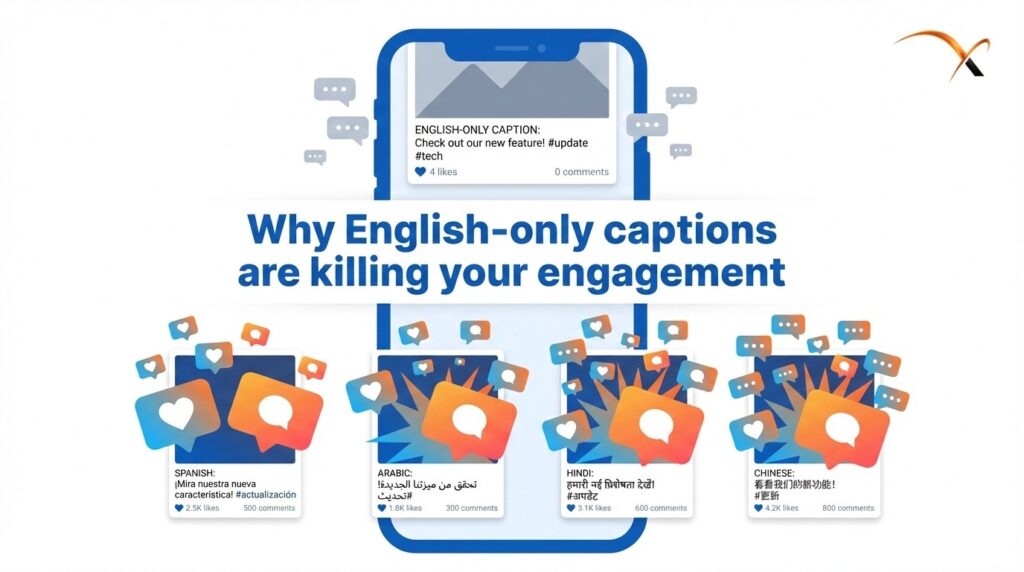
And how Media & Entertainment Transcription helps you reach the audience you already have The Global Audience Myth: “Everyone Understands English” For years, brands believed English was the universal language of the internet. While English remains widely used online, social media behavior has changed dramatically. Platforms are no longer local communities — they are international viewing spaces where people consume content from different countries every minute. Viewers don’t just want to recognize a language. They want to effortlessly understand it. When your video uses English-only captions, a large portion of viewers silently struggles to follow along. They may understand parts of it, but not enough to react, comment, or stay until the end. The algorithm interprets that hesitation as lack of interest. Your content quality didn’t fail.Your accessibility did. This is exactly where Media & Entertainment Transcription becomes essential — not as an accessibility feature, but as an engagement strategy. Social Media Is Now a Silent-First Experience Most videos today are consumed in environments where sound is inconvenient: public transport, offices, classrooms, waiting rooms, or late-night scrolling. Users watch without audio and rely entirely on text. Captions are no longer optional support text.They are the primary communication layer. If a viewer reads quickly and comfortably, they stay.If they struggle to interpret meaning, they leave. English captions often require translation in the viewer’s mind. That extra mental effort increases cognitive load. Social media users avoid cognitive effort; they scroll instead. Through accurate Media & Entertainment Transcription, captions become readable rather than decodable. The viewer no longer translates — they absorb. Engagement Is Driven by Comprehension, Not Exposure Many businesses misread analytics. A post may get impressions globally but engagement remains low. The reason is simple: visibility does not equal understanding. When captions match the viewer’s language, three things happen naturally: Algorithms interpret these behaviours as quality signals. Without proper Media & Entertainment Transcription, your content reaches audiences but never communicates with them. Social media platforms reward communication, not broadcasting. Partial Understanding Creates Passive Viewers A viewer who understands only 70% of your message behaves very differently from one who understands 100%. They rarely: They watch briefly, then move on. This silent audience is often the largest segment of international reach. English-only captions unintentionally turn potential customers into passive viewers. Professional Media & Entertainment Transcription removes that hesitation and converts viewers into participants. Algorithms Measure Retention, Not Language Platforms do not detect whether your grammar is correct or whether your vocabulary is impressive. They measure behaviour. Retention curve, completion rate, replay frequency and interaction speed decide reach. Localized captions produced through Media & Entertainment Transcription directly affect these signals because viewers stay longer when comprehension is immediate. Even a small increase in retention dramatically expands organic distribution. In many cases, engagement problems are misdiagnosed as marketing issues when they are actually comprehension issues. Cultural Context Matters More Than Translation Literal translation alone is not enough. Social media language relies heavily on tone, humour, and familiarity. English phrases often carry cultural assumptions that do not translate automatically. A caption may be grammatically correct yet emotionally distant. Professional Media & Entertainment Transcription adapts phrasing to natural speech patterns. Instead of reading like subtitles from a documentary, captions feel like a native conversation. This subtle shift changes how audiences perceive authenticity. People interact with content that feels local, even when the brand is global. Accessibility Expands Market Reach Automatically Captions initially became popular for accessibility reasons, but today accessibility and marketing overlap. The more people who can comfortably consume your content, the more markets you enter without additional advertising cost. Accurate Media & Entertainment Transcription helps content function across: Instead of creating new campaigns for each audience, the same content becomes understandable everywhere. From Content Creation to Content Communication Many brands invest heavily in visuals, editing, and storytelling yet overlook the final step — making the story understandable to everyone who sees it. English-only captions assume familiarity.Localized transcription ensures clarity. Once captions align with audience language, content performance often changes without any modification to the video itself. Reach grows because comprehension grows. Media & Entertainment Transcription does not change your message.It allows the message to arrive intact. The Real Reason Engagement Drops Low engagement rarely means viewers dislike your content. More often, they never fully receive it. A viewer who pauses to mentally translate loses emotional momentum. Emotional momentum is what produces reactions and shares. Remove that pause and behaviour changes immediately. English-only captions introduce friction.Multilingual transcription removes friction. Conclusion: Engagement Begins With Understanding Social media rewards clarity, familiarity, and comfort. Audiences interact with content they instantly understand, not content they must interpret. English alone no longer represents the internet’s audience. It represents only a segment of it. By investing in Media & Entertainment Transcription, brands transform content from globally visible to globally understandable. When understanding improves, watch time rises. When watch time rises, algorithms respond. When algorithms respond, engagement follows. Your reach was always there.Your captions just needed to speak the audience’s language. Read Our More Blogs: Medium
Certified vs. Non-Certified: What to Look for in Online Translation Service Providers

With our globe now connected, the demand for translation services has never been greater as companies expand internationally, individuals apply for visas, or adjust documents. It will not take long to discover that there are countless online service providers, so the decision usually comes down to 1 key issue – certified or not certified? Knowing the difference is vital for the success of your project, and Tranzlatex will help avoid costly, embarrassing, or even legal issues. Tranzlatex is among the best certified online translation service providers to meet this need. What Makes a Translation Service “Certified”? At first, the word “certified” can be a little confusing. When we say a translation is “certified,” it does not mean it is a translation done by a person with a generic language degree. When we say that a translation is “certified”, it means we will provide a signed document. Thus stating that the translation is a complete and accurate translation of the original document. More importantly, certification refers to the service, and not the individual. Many professional translators are certified members of a professional organization. However, engaging the services of a certified translator is what we recommend. When Certified Online Translation Service Matters Most Certified online translation service providers use certified translations to ensure your translation is true to the source. No matter the way your documents are being submitted, you must use a certified service if you are engaged in any of the following: No doubt using documents that were translated by a non-certified service will lead to your application being either denied or delayed. How Certified Providers Ensure Accuracy and Reliability The key point is that the value of a certified vendor is based on its process rather than just translation. They use a multi-process quality assurance (QA) process. There are: This is very different from so-called non-certified vendors, which are likely to do translation and proofreading. Weighing Price vs. Professional Credentials Certified translations are more expensive. When you search for a certified online translation service providers, you’re paying for knowledge and expertise from a professional as well as a multi-step quality assurance process and assumption of legal liability. Both on average find pricing based on either per-word or per-page. Comparing Service Delivery Between Certified and Non-Certified Providers A certified provider will give you a realistic time frame. Consider a complicated, legal document: it will require detailed, human effort and cannot realistically be produced in two hours without sacrificing quality. These firms need to manage their capacity to maintain their standard. Some non-certified providers may promise that they can deliver that same project in a fraction of that time because they may rely on automation or stressed, overworked freelancers. However, for important projects, a provider that promises quality work and gives a more realistic turnaround time would likely be the safer option. Warning Signs of Unreliable Translation Services Despite this, you must watch out for these: Why Certified Online Translation Service Providers? When your documents’ accuracy and acceptance are critical, choosing the right partner like Tranzlatex is vital. The following distinguishes our services from our competition: Final Words About Certified Online Translation Overall, a non-certified solution could be appropriate for personal, low-stakes situations where flawless communication is not expected. Certified online translation service providers like Tranzlatex are not just a suggestion, as they will be in any formal, legal, medical, or business-critical use case. Visit their website to know more. Follow us on Medium.